
New Martinsville Previous Resident Sources
No single roll identifies every person who occupied a New Martinsville address. The current parcel card supplies the stable map and parcel keys. Recorded deeds then identify transfers of an interest in that land. A city directory can add a dated householder, while probate, court, newspaper, and church material may explain a change between editions. Keep the source's own label. An owner, grantor, grantee, taxpayer, or mailing addressee should not be called a resident unless another record ties that person to occupancy.
| Source | Years It Covers | Where Held | What It Shows |
|---|---|---|---|
| Wetzel County deeds and instruments | Coverage dates not posted | County Clerk and document inquiry | Grantor, grantee, instrument, book/page, and legal description |
| Assessor parcel history | Available years vary by parcel | WV assessment detail | Current and prior owner labels, sales, addresses, and parcel key |
| Combined city directories | Selected editions, 1969 to 2000 | WV State Archives | Dated New Martinsville, Paden City, and Sistersville listings |
| County archive microfilm | Nineteenth into twentieth century, record-specific | WV State Archives | Deeds, wills, fiduciary books, land, tax, court, and vital records |
| Wetzel court collection | 1846 to 1872 | WVU Regional History Center | Land, estate, road, license, lien, and tax references on 18 reels |
For a recent address, start with the assessor and Clerk. For a mid-to-late twentieth-century household, test the archive's intermittent directory years. Earlier work often shifts to deed books, wills, fiduciary files, tax material, and the WVU collection. The New Martinsville Public Library can help with local history, genealogy, microfilm, HeritageQuest, and in-library FamilySearch access, though it does not publish an exact local directory run online.
Follow Wetzel County Owners Backward
The state assessment search accepts Wetzel County, district, owner, street, map, parcel, class, land-use, value, acreage, sale-date, and sale-price criteria. Open the detail record instead of relying on a map label. Copy the root parcel ID, legal description, physical and E-911 address labels, owner spelling, book/page, and each dated sale or prior-owner entry. These keys keep the same tract in view when a street number has changed.
- Find today's parcel and record its full legal description, map and parcel numbers, current owner label, and every address type.
- Use the book/page or current owner's name in the Wetzel County Clerk's document inquiry. Note the instrument date and seller, who is the grantor.
- Search that seller as a grantee to locate the deed by which the seller acquired the parcel. Match the legal description, not just the street name.
- Repeat the grantee-to-grantor handoff. Record gaps, name variants, estates, liens, leases, and probate references without assuming they show occupancy.
- When the online path ends, ask the Clerk for the deed book or instrument and use State Archives microfilm for older material.
- Grantor and grantee
- The grantor transfers an interest; the grantee receives it.
- Chain of title
- The linked sequence of recorded transfers for the same land.
- Legal description
- The lot, boundary, or tract wording used to identify land even when a street label changes.
The county portal was behind a CAPTCHA during research, and its start date and image fee schedule were not published. Treat it as a convenience index. The Wetzel County Clerk at 200 Main Street is the official verification and copy channel. State whether an uncertified research copy or a certified copy is needed, and give the parcel, parties, rough date, instrument type, and book/page when known.
Three New Martinsville Address Labels
A public city-owned parcel gives a clear warning for previous-resident work. Its assessment detail labels 191 Main Street as the owner's mailing address, 527 Main Street as the physical address, and 527 Market Lane as the E-911 address. The parcel also carries a legal description and book/page. All three street labels are valid within their own systems. None should silently replace another in research notes.
The official sample parcel detail shows how the tax system separates these fields:
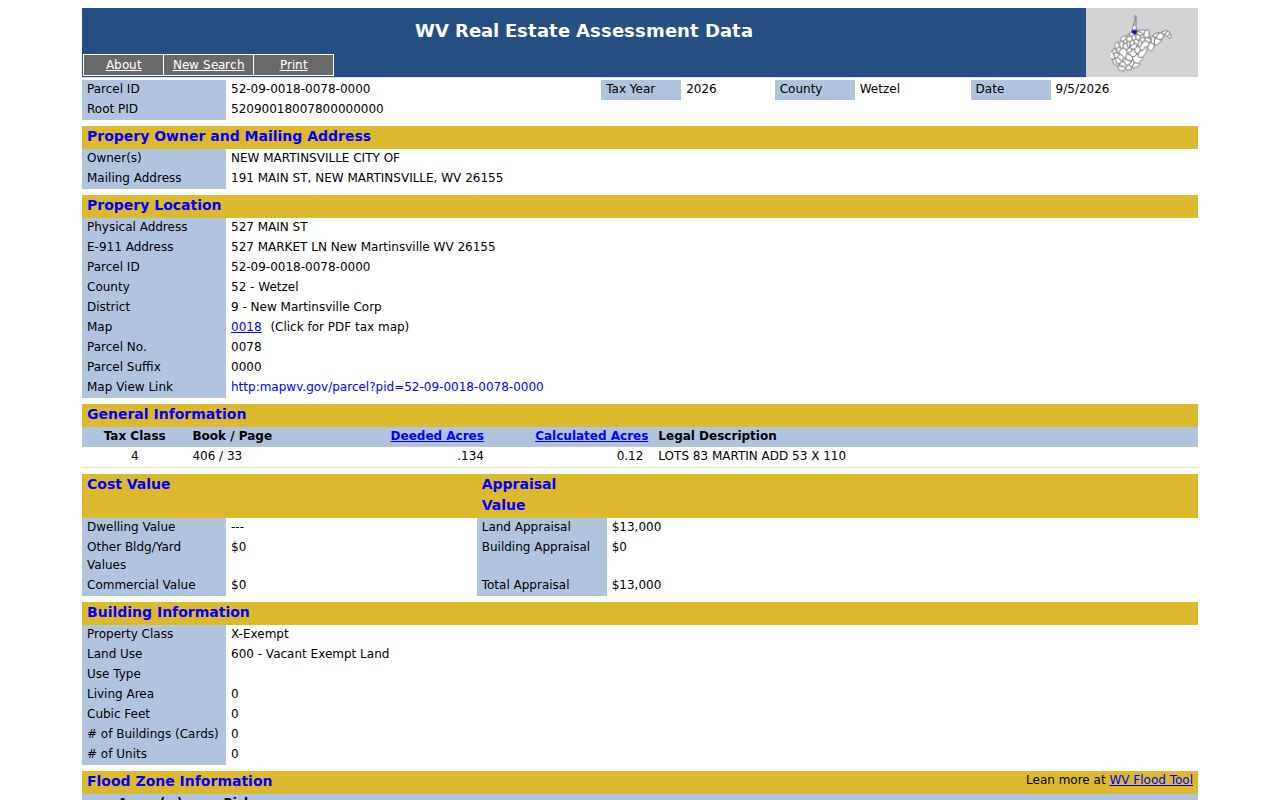
The image concerns civic land, not a private household. Its value is the method: transcribe each label, source, and date before moving backward. A past resident might appear under a physical street, an older rural route, or a directory's local form while the tax owner received mail elsewhere.
New Martinsville Numbers Can Shift
Wetzel County E-911 may readdress a whole road when numbers are duplicated, out of sequence, use A/B suffixes, or fall on the wrong odd or even side. A shared drive can receive a road name when it meets county criteria. New numbers follow a 5.28-foot interval, which yields 1,000 possible numbers per mile split between odd and even sides. The county says mail updates can take about a year after a change.
That local system explains why an old deed or directory address may not match the current emergency label. It does not prove that previous residents moved. Search the parcel number, lot, legal description, adjoining owners, and both forms of the road name. No verified citywide renumbering year or public before-and-after crosswalk was found, so do not assign a date to a change unless the E-911 office or a dated record supplies one.
Search Martinsville Before New Martinsville
The place name itself adds a time key. The town was platted as Martinsville in 1838, incorporated in 1848, and renamed New Martinsville in 1871. A search limited to the modern name can miss earlier land, court, newspaper, and estate references. Use both place names, then preserve the wording printed in the source.
Industrial history also affects the record trail. Late nineteenth-century oil and gas activity, the Stringtown field, rail and river traffic, glass, and oil-well-supply firms created deeds, leases, licenses, liens, business notices, and estate papers. Those records can explain a name or tract connection. They still need an address-linked directory, census line, obituary, or other dated source before they support a claim about who lived here before.
New Martinsville Archives Fill Gaps
The WV State Archives directory list names selected combined New Martinsville, Paden City, and Sistersville editions for 1969, 1973, 1975, 1977, 1980, 1982, 1984 through 1987, 1989 through 1990, 1992, 1994, 1996, and 1998 through 2000. The missing years are real gaps in the known run, not proof that a household left. Cite town, edition year, page, exact name, and exact address.
The State Archives also lists Wetzel County deeds, wills, fiduciary and court books, land and tax records, plus vital records on microfilm. WVU's 18-reel Wetzel County court collection spans 1846 through 1872 and can supply land, estate, road, license, lien, and tax-apportionment clues. No New Martinsville-specific Sanborn edition was verified. Use the Library of Congress search method as a future research route, but do not claim a local map exists without a catalog hit.
The local library is the practical bridge between a catalog and a usable citation. Ask whether staff can check an address index, newspaper, obituary file, directory, or vertical file for a narrow year range. Give every known street form and surname spelling. HeritageQuest and in-library FamilySearch access may add census and family links, but the saved result should name the original collection, image, page, and date. A database hint by itself is not proof that one of the previous residents occupied the target house.
Wetzel Files Still Need Preservation
Older records do not always move neatly from a courthouse book to a web screen. In August 2026, the Wetzel County Commission allocated $30,000 to preserve brittle old Circuit Clerk files. That recent action is a practical reminder that an online no-result may reflect format, condition, indexing, or custody rather than the absence of a record.
Ask by date range, record type, party name, parcel or lot, and known book/page. A clerk can often route a request to a paper volume, microfilm reel, or archive series. Keep a search log that says which online index, office, edition, and name or address variant was checked. This makes a later follow-up precise and keeps an unresolved gap from turning into a false conclusion about past residents.
For an estate transition, request the will, probate file, appraisement, or fiduciary book cited by the index. An heir named in a file may have received an interest without living at the address. Likewise, an oil and gas lease can tie a person to mineral rights rather than the home. Note the role printed beside each name. That small habit keeps the deed chain useful without stretching a legal or financial interest into an unsupported residence claim.
Confirm New Martinsville Past Households
Ownership is only half the test for previous residents. A directory entry is a dated listing, and a census schedule can show a household at one enumeration point. An obituary may say a person was "of" a street, while a probate file can link an owner to an estate or heirs. Keep those statements separate. The known publication years and how entries read are covered in the New Martinsville directory book resource.
Use a simple flow: current parcel to prior-owner candidate, deed date to directory editions on each side of that date, then a census or local-history source for household context. Search both Martinsville and New Martinsville when the date calls for it. Check spelling variants and nearby addresses. Record an unproved link as a possible match and name the second source that would confirm it. Library staff, the Wetzel County Museum Scrapbook Project, church records, newspapers, and probate files can bridge years when no directory edition survives.
Lawful use. Research previous residents for house history, genealogy, estate work, or personal curiosity. West Virginia law prohibits stalking and harassment, so never use an address trail to track, threaten, or pressure a living person.